Weld-on bolt tab
A flat weld-on tab with the bolt hole already engineered — laser-cut, deburred, and rated in axial pull. The bolt is the fuse: the plate is deliberately built past the bolt so the failure you get is the one you designed for.
SS304 · EN 10088-2 1.4301 · 534 g

3D solid — STEP
CAD-ready · exact geometry
All tangent arcs and lines. No splines, no facets. This whole profile is 4 vertices, 1 of them true arc segments, plus 1 full circles. Every curve is a true arc your CAM follows as an arc — not a chord, not a polyline pretending to be a radius, not a mesh someone exported and hoped you would not measure.
A real solid, not a mesh. Watertight, positive volume, and the mass agrees with the flat profile it was cut from — every SKU is checked for that before it ships.
Drop it straight into your assembly. SS304 · EN 10088-2 1.4301, 534 g as modelled, with the holes deducted.
Choose by load, or by the plate you already have — every bolt size is also offered on thinner plate, widened so it still develops the full bolt rating.
Rated drawing
A4 · vector PDF · third angle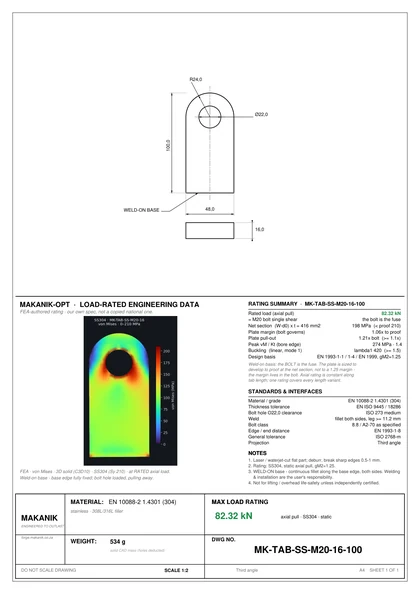
Plan view, projected front view, and a load-rated data block — drawn by the engine from the same DXF you get, so the view and the cut file cannot disagree about what the part is.
Every dimension on it is checked for legibility before the sheet is issued: nothing off-sheet, nothing sitting on the part, nothing on top of another dimension.

FEA report
stress · deflection · FoS · buckling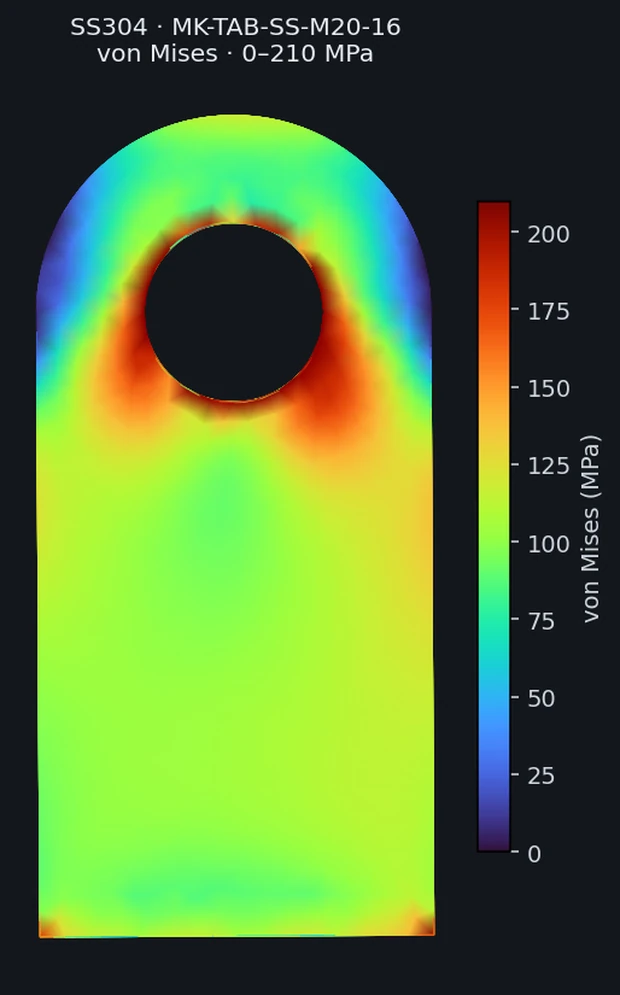
Our own spec, not a copied national one. A linear-elastic solve plus a linear eigenvalue buckling step on the same model, applied at the rated load with the real restraint — then read against yield, against margin, and against stability.
Peak 274 MPa at the bore, 0.067 mm of deflection that fully recovers, and mode 1 buckling at λ₁ 420 × the rated load. The rating is set by the governing criterion, and the report says which one and why.
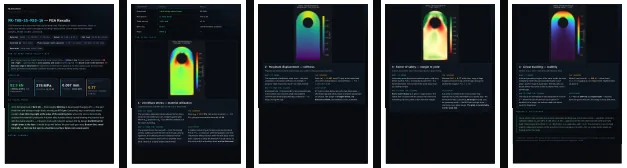
What you get
MK-TAB- Flat DXF — freeThe flat DXF cut file is free for every SKU in this lane.
- STEP solidWatertight 3D, CAD-ready, exact to the SKU.
- Rated drawingA4 vector PDF with the load-rated data block.
- FEA reportStress, deflection, FoS, buckling, and the method behind them.
Steel S275 · Stainless SS304 · Aluminium AL6082 — 585 SKUs from 57 FEA masters.