Saddle Tab
A bolt tab whose base is cut to your pipe's outside diameter, so it sits down on the run instead of bridging it — with a gusset keyed into the fin through a cut slot. Two directions are rated, and they are not interchangeable: the radial pull the part is built for, and the much smaller push into the gusset.
EN 10025-2 S275JR · Ø114,3 host · 686 g

3D solid — STEP
CAD-ready · exact geometry
All tangent arcs and lines. No splines, no facets. The cut file for this part is 7 arcs, 1 circle, 4 straight runs and 6 polylines — and zero splines. Every curve is a true arc your CAM follows as an arc, including the saddle: R57,5, cut to the pipe, not approximated to it.
The gusset is keyed, not just welded. A tongue on the gusset drops into a slot cut through the fin — 10,3 × 40,0, which is the plate thickness plus 0,3 mm of fitment clearance, so it locates on assembly rather than being held square by hand while you tack it.
A real solid, not a mesh. Watertight, positive volume, and the mass agrees with the flat profile it was cut from. 10 mm S275, 686 g as modelled with the hole and slot deducted.
A second gusset is an optional fitting on the same part number — the same profile turned over on the other face. It does not change F1; it makes F2 apply both ways at the same value.
Rated drawing
A4 · vector PDF · third angle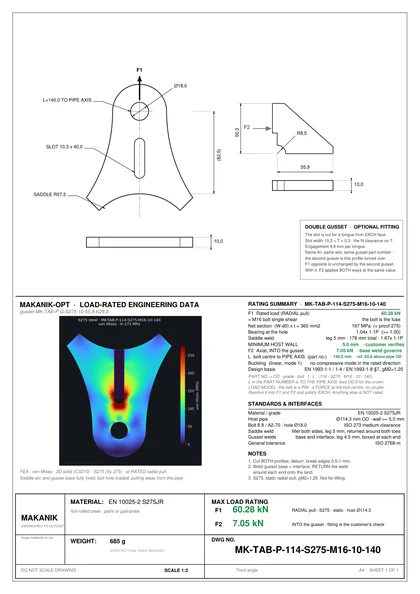
Plan view, projected section, and a load-rated data block — drawn by the engine from the same DXF you get, so the view and the cut file cannot disagree about what the part is.
The load directions are drawn on the view as labelled vectors, F1 and F2, with the same labels on the rating rows. A rating whose direction you cannot find on the drawing is not much of a rating.
The length in the part number is the bolt centre to the pipe axis — the dimension you actually design to. Fin height above the crown is carried as a bracketed reference.

FEA report
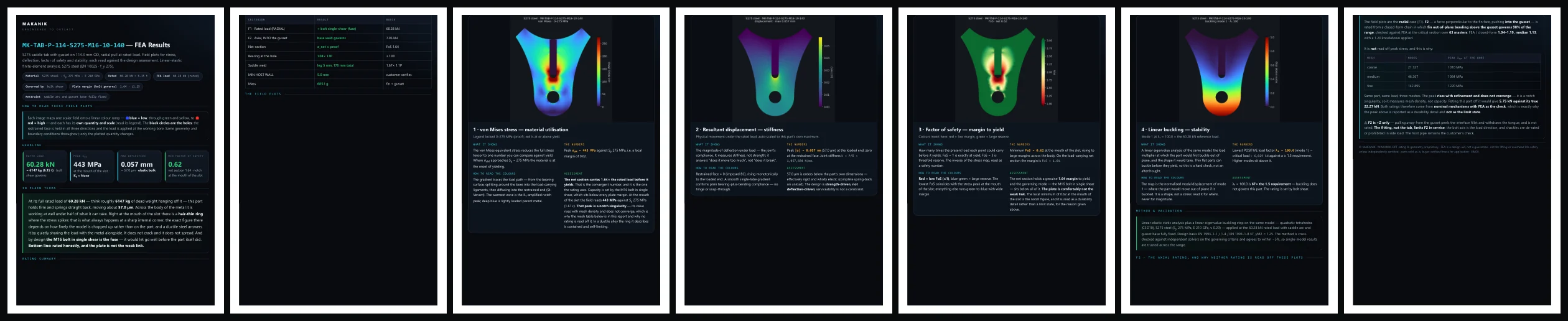
stress · deflection · FoS · buckling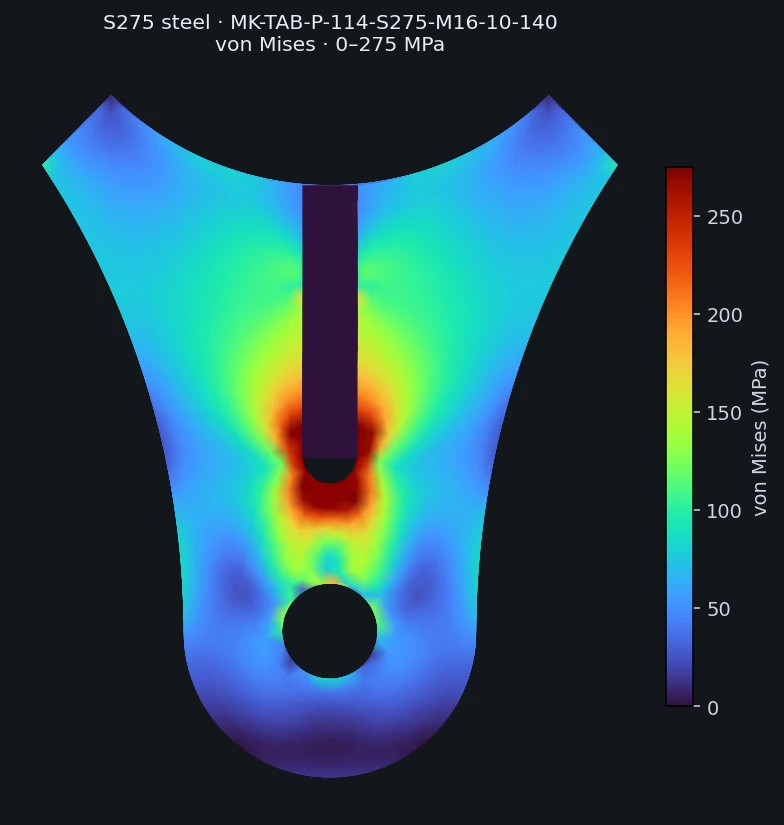
Our own spec, not a copied national one. A linear-elastic solve plus a linear eigenvalue buckling step on the same model, applied at the rated load with the real restraint — saddle arc and gusset base fully fixed, the bolt hole loaded and pulling away from the pipe.
The bolt is the fuse. F1 is set by single shear in the M16, with the plate deliberately built past it, so the failure you get is the one you designed for. The report names the governing criterion and says why it governs.
One report covers the whole length family. The radial case is length-independent, so every length on this pipe size, bolt and material shares one solve — which is why 62 solves rate 187 part numbers. Your part's own F2 and minimum host wall are on the drawing, because those do change rung by rung.
The minimum host wall is on the wall you measure, not the wall you ordered. The tube standards themselves allow the wall to run under nominal — EN 10219-2 and EN 10210-2 −10%, EN 10255 −10% welded and −12,5% seamless, EN ISO 1127 −7,5% to −15% by class — so a nominal 5,0 mm pipe can be a fully compliant 4,25 mm. Work to the standard your pipe is made to, or measure it. The host pipe is your structure and your check.
What you get
MK-TAB-P- Flat DXF — freeThe flat cut file is free for every SKU in this lane, at your chosen length.
- STEP solidWatertight 3D, CAD-ready, exact to the SKU.
- Rated drawingA4 vector PDF, both ratings, drawn load directions.
- FEA reportStress, deflection, FoS, buckling, and the method behind them.
Steel S275 · Stainless SS304 — 187 SKUs from 62 FEA masters, across 9 pipe sizes.